Build a Birdhouse
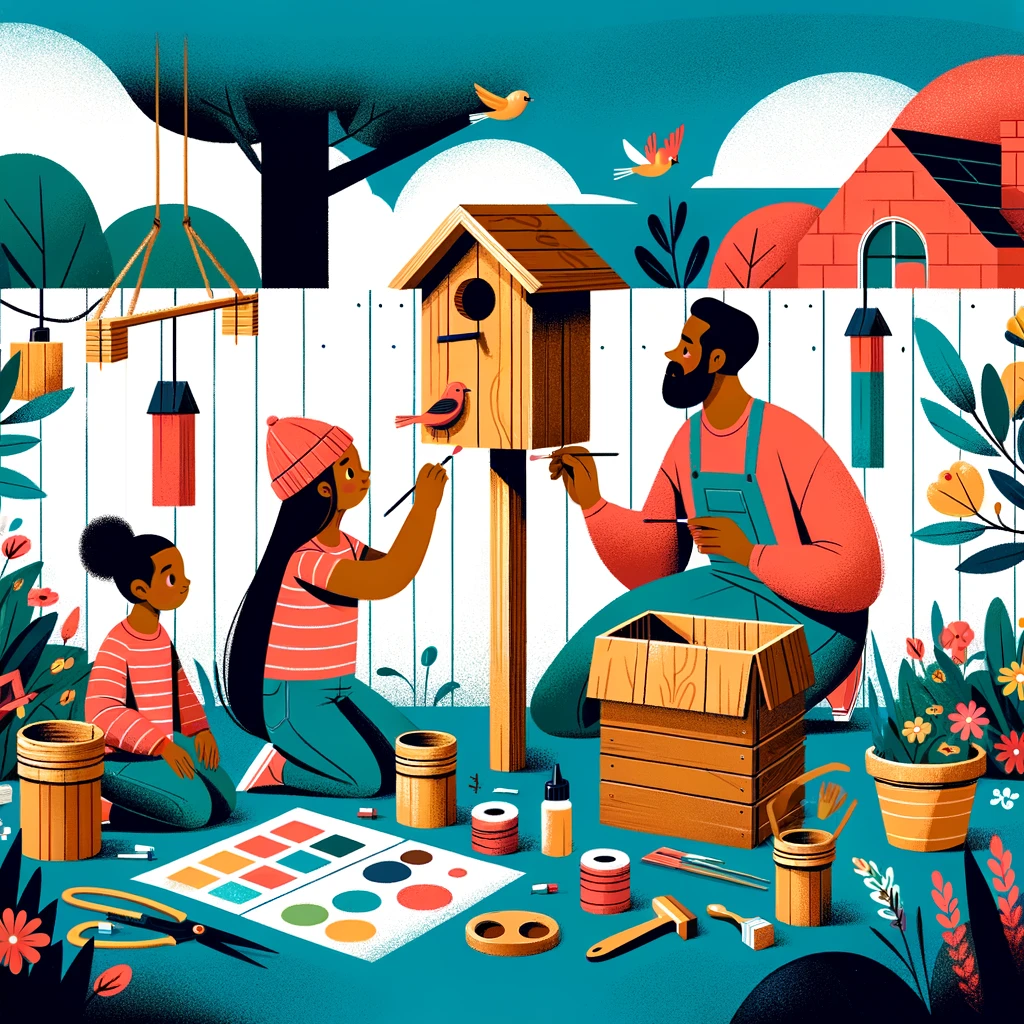
Half a day of honest woodwork — a simple six-panel nest box built from one plank, with kids on measuring, hammering and assembly and the adult on saw and drill. Mounted properly, it stands a real chance of tenants by spring, which makes it a craft with a sequel.
Last updated
Before you start
This is many kids' first real woodwork, and the pitch is irresistible — we're building an actual house for an actual bird, with actual tools. One 15cm-wide plank about 1.4m long yields all six panels of the classic nest box; ask a DIY shop to cut the panels to length and the hard part is done before you start.
The detail that decides whether birds ever move in: the hole size, and no perch. A 25mm hole suits blue tits, 28mm great tits, 32mm sparrows — drill to your local clientele. And skip the little perch under the hole entirely, however unfinished it looks; residents don't need it and predators love it. Tell the kids they're building to bird building regulations, which happen to be strict.
How it goes
The drawing office
Sketch the box together and mark up the plank — back, front, two sides (one sloped for the roof's fall), base, roof. Kids measure and pencil every line; measuring twice gets taught here or never. Adult cuts while kids sand each panel smooth — sanding is the great underrated kid job, satisfying and genuinely useful.
The hole
Mark the entrance high on the front panel, choose the diameter for your target tenant, and drill it — adult on drill, kids on countdown. The moment the hole appears the pile of wood becomes a house; expect someone to look through it immediately. Drill three small drainage holes in the base while the drill's warm.
Assembly
Glue then nail, panel by panel — kids hammer with the nail started by you (two taps to set it, then hand over). Base inside the walls, sloped roof overhanging the front, and the roof either hinged or fixed with the rubber strip for the annual clean-out. Gaps are ventilation; wonkiness is character; birds have no building inspector.
Handover to the tenants
No paint on the outside walls or hole surround — bare wood weathers to invisible, which is what tenants want. Mount it two to four metres up, hole facing between north and east away from midday sun and prevailing rain, tilted slightly forward, nowhere a cat can stage from. Then the hard part — leave it alone. Occupancy checks are for spring, from a distance, with the patience of landlords.
Make it fit your kids
Sanding crew and official hole-lookers-through. They hand nails with enormous ceremony and should be at arm's length whenever the hammer swings.
Measuring, marking, sanding and supervised hammering — the core workforce. The moment the hole gets drilled belongs to them.
Near-independent builders — they can run assembly with you on cuts and drilling only. Give them the tenant research too — which species, which hole, which aspect.
Full build autonomy with the saw under supervision, or scale up — a two-box terrace, a camera-ready box with a side window, or an open-fronted robin design of their own drafting.
One rough sawn plank is a few pounds; nails and glue are junk-drawer stock. Skip the hole saw by drilling a ring of small holes and finishing with sandpaper — slower, uglier, entirely functional.
If it’s going really well
- The feeder economy — a feeding station nearby (not too near) makes your garden the full-service neighbourhood.
- The nest-box diary — occupancy notes each spring, cleaned-out contents examined each autumn like archaeology.
- Register the box with a garden-bird survey and the kids' observations become actual citizen science.