Backyard Astronomy
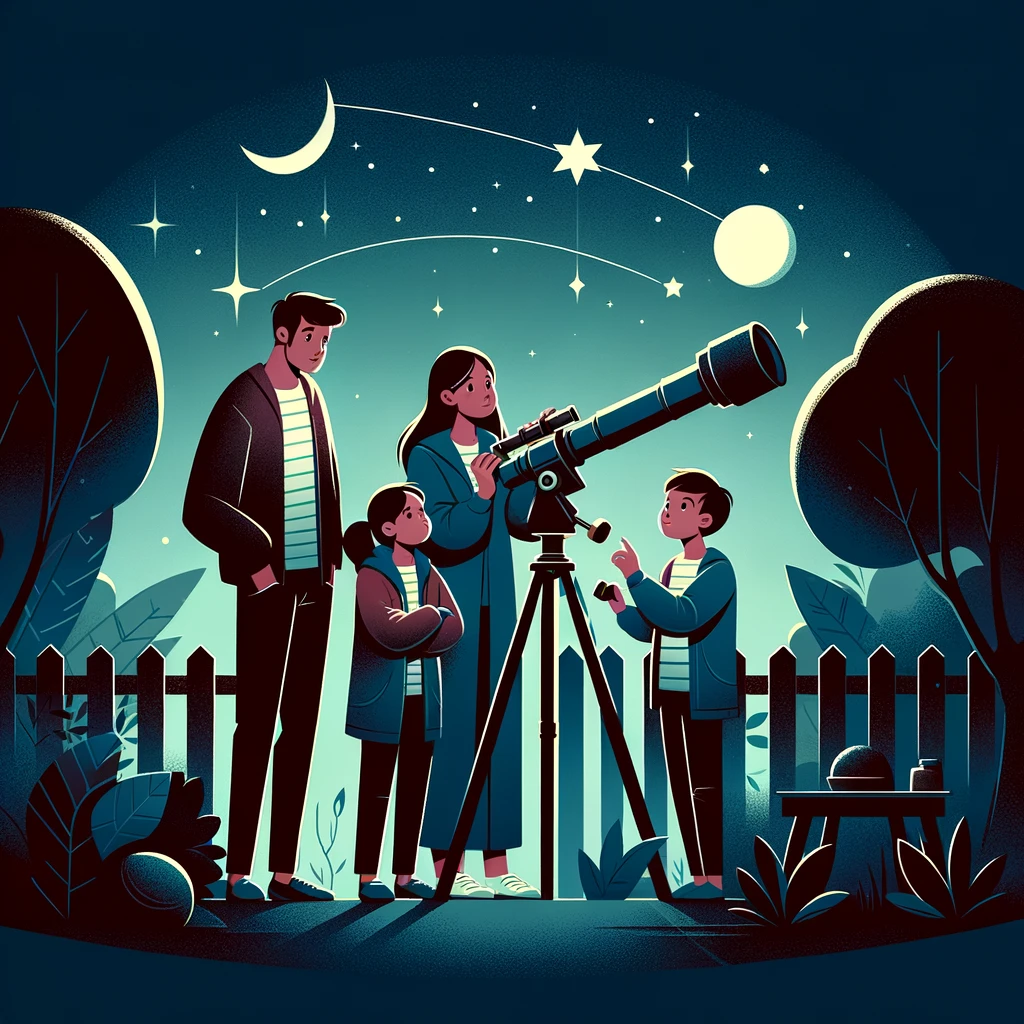
An evening backyard astronomy activity for families using blankets, dark adaptation and a short target list. It turns a regular night into a memorable science moment with almost no cost.
Last updated
Before you start
Backyard astronomy fails when it's oversold as telescope territory — and succeeds wildly as a blanket, a flask and the naked eye, which see more than anyone expects. The Moon's terminator (the shadow line, where craters throw relief), the brightest planets (checked that afternoon on any free sky app — Venus and Jupiter outshine every star), one satellite trundling across, and with patience, a meteor. That's a full evening's astonishment with zero glass.
The one rule that makes the difference: twenty minutes of real darkness before judging the sky. Eyes adapt slowly and phones reset the clock every time — so the torch gets a red-film hat (rubber band, red sweet wrapper), screens go face-down, and the waiting itself becomes the ritual. What emerges from a dark-adapted garden sky, even in town, reliably shocks first-timers.
How it goes
Mission planning
The afternoon briefing — check what's up tonight (Moon phase, visible planets, the space station's pass times if luck is in) and pick three targets, no more. A half Moon beats a full one (the terminator's shadows show craters; full Moon is flat glare — the counterintuitive tip that makes you look like a professional). Blankets staged, flask filled, bedtimes negotiated with the gravity of a launch window.
Lights out
Everything off that can go off — house lights, phones face-down, the torch wearing its red hat — and the lying-down begins. The wait is programming, not dead time — this is when eyes sharpen and the first "wait, there are MORE now" lands, usually around minute twelve, from whoever doubted loudest.
The tour
Three targets, taken slow — the Moon first (binoculars if owned; the terminator craters get an honest gasp), the planet second (steady light, no twinkle — the tell taught in one sentence), and one constellation traced arm-in-arm (the Plough to the North Star is the classic double win). Satellite-spotting fills the gaps — a moving "star" that doesn't blink is a spacecraft, and knowing that changes how everyone lies there.
Flask and the big questions
Hot chocolate service, lying back down, and the conversation the dark reliably produces — how far, how old, whether anyone's looking back. Answer honestly including the "nobody knows" ones; the garden at night is the right venue for nobody-knows. Close with the meteor vigil — five silent minutes, eyes wide — and whether one falls or not, the silence itself is the memory that files itself.
Make it fit your kids
A short shift — Moon, one planet, carried in at the first shiver. Their contribution is spotting "the biggest one" and falling asleep mid-vigil, both performed perfectly.
The wonder tier — dark adaptation astonishes them audibly, the satellite is a spacecraft with people in it (say so; watch the face), and the constellation traced tonight gets found again unprompted for months.
Hand over the mission planning — app, targets, pass times — and the binoculars. The how-far maths (the Moon at motorway speed takes six months) lands here with visible recalibration.
Astrophotography is the door — a phone on a propped deckchair, night mode, ten-second exposure, and the star field they capture outranks the lecture nobody gave. The nobody-knows conversation goes deepest at this age, in the dark, sideways.
Free at every altitude — the sky charges nothing, the apps' free tiers cover planning, and the red filter is a sweet wrapper. The flask was already in the cupboard.
If it’s going really well
- The meteor-shower booking — the Perseids or Geminids circled on the calendar as the season's fixture, peak night, alarm set.
- The Moon diary — its shape sketched nightly for a month from the same window; the pattern discovered beats the pattern taught.
- Build the indoor planetarium for cloudy weeks — the ceiling version keeps the constellations warm between clear skies.