Origami Animals
An hour of origami sequenced for success — the two-fold dog face first (instant win), the cat, the boat, then the jumping frog as the graduation piece. Fold-along teaching, crisp creases, and a menagerie with faces drawn on by the end.
Last updated
Before you start
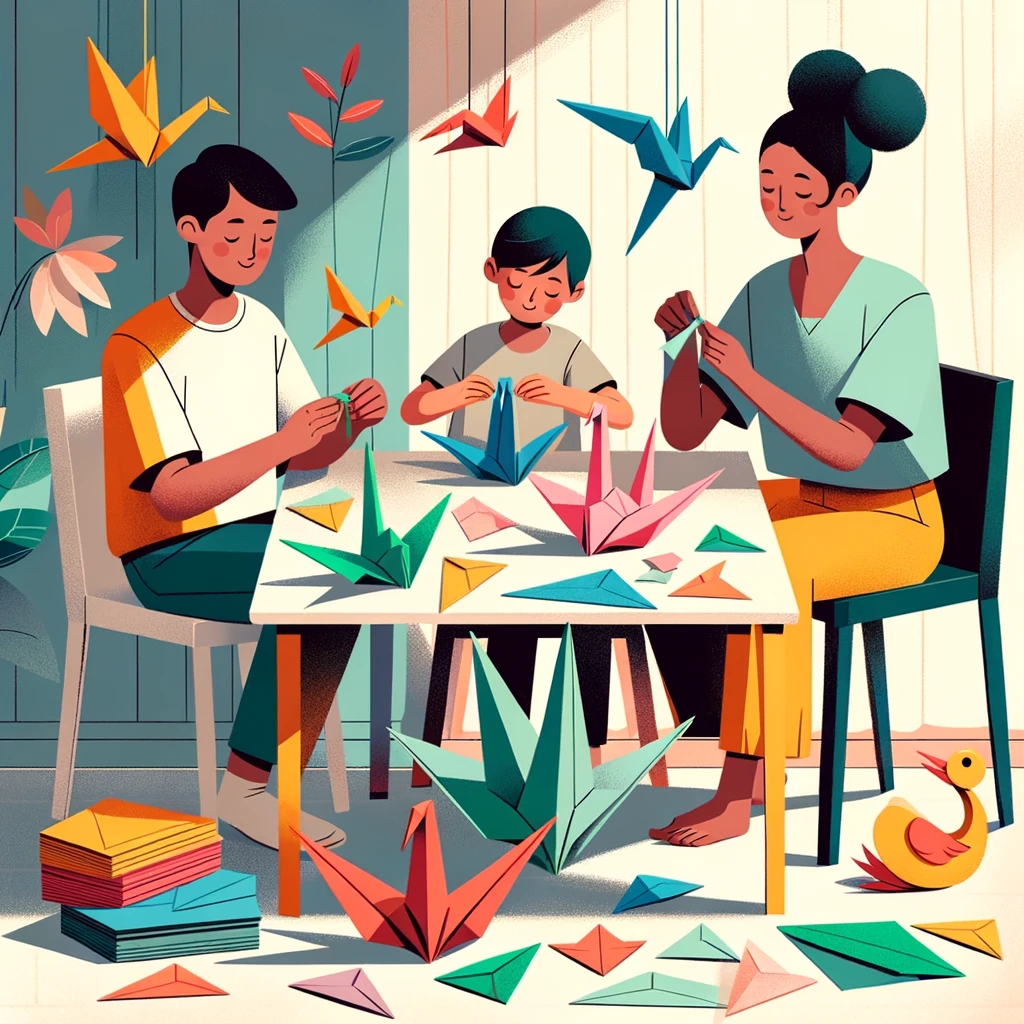
Origami with kids fails in one predictable way — starting with the crane. The crane is beautiful and it is a wall; the correct syllabus starts with the dog face (two folds, then draw the face — a three-year-old succeeds inside a minute) and climbs through the cat, the boat and the fortune teller to the jumping frog, whose spring-loaded leap is the hour's guaranteed finale. Success order is everything; each win buys patience for the next fold.
Two technique rules carry the whole session: fold on a hard surface, and crease like you mean it — a thumbnail dragged along every fold. Soft laps and timid creases make every model sad; sharp creases make even wonky models work. Square paper matters less than confidence — cut printer paper square and it folds fine.
How it goes
The dog face
Triangle fold, two ear folds, face drawn on — everyone succeeds, immediately, including the smallest and the adult who claims to be bad at this. Name the dogs. The morale banked here funds the whole hour; do not skip the easy win on grounds of ambition.
The cat and the boat
The cat adds two folds to the dog's logic; the boat introduces the open-and-flatten move — the first real origami technique, taught slow, hands over hands where needed. The boat floats (briefly, in the washing-up bowl, with ceremony), which buys the crease discipline for what's coming.
The jumping frog
The summit — folded along step by step, everyone on the same fold before the group moves on ("nobody folds ahead" is the classroom's one law, and it protects the strugglers). The final body-fold loads the spring; press the back, and the frog JUMPS — a payoff so reliable it's been converting fold-sceptics for generations. Frog games follow immediately — distance, landing zones, the cup Olympics.
The menagerie
Free folding — repeats of the favourites (repetition is mastery arriving; the third frog is always the best frog), faces and markings drawn on everything, and the zoo arranged on the shelf with name cards. One model gets taught BY a kid to another human being before the hour closes — teaching a fold is the proof of owning it, and they visibly grow an inch doing it.
Make it fit your kids
The dog face with help, the face-drawing solo, and custody of the finished zoo between sessions. Their folds are approximate and their naming of the animals is the hour's best content.
The full syllabus lands here — boat, fortune teller, frog and the beginnings of crease pride. The fortune teller in particular exits the session and runs the playground for a week.
Diagram literacy is the unlock — reading fold notation independently opens the whole art form. Set the crane as the term goal and the modular cube as the sibling-collaboration piece.
Origami's deep end is genuinely deep — tessellations, modular geometry, one-uncut-square sculpture. A teen shown the mathematical end of the art (and the online masters at work) either shrugs or disappears into it for a season; both are fine.
Printer paper cut square — free in every meaningful sense, with the coloured-paper upgrade costing a pound if the zoo demands plumage.
If it’s going really well
- The frog Olympics — distance, accuracy and the cup dive, with a league table and team colours drawn on competitors.
- A mobile of the menagerie — thread and a coat hanger turn the zoo into bedroom architecture.
- The thousand-crane ambition — the family folds toward a big number across a season, a crane a day, for the legend of it.