Indoor Bowling
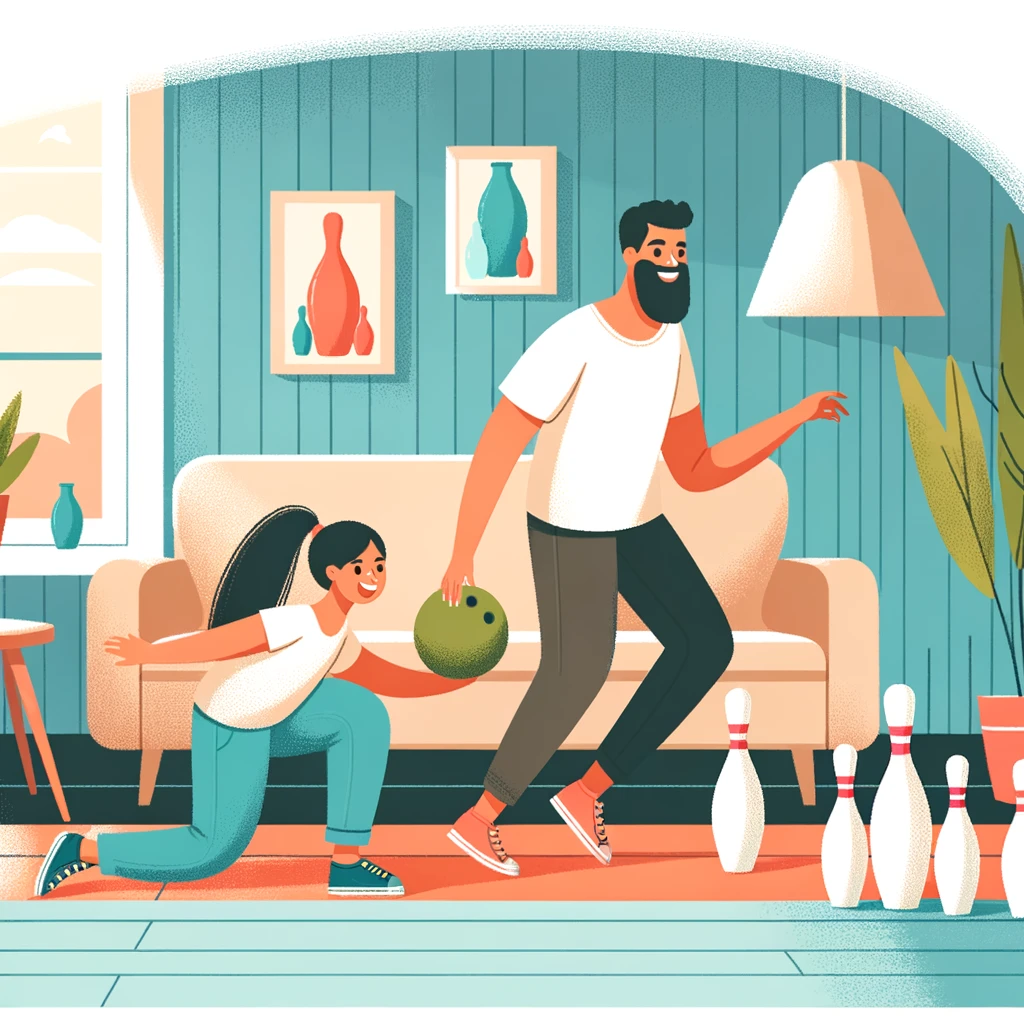
An hour of hallway bowling done properly — water-weighted bottle pins, a taped lane and foul line, real(ish) scoring, and the pin-setter rotation that makes the waiting part of the game. Cheap, loud in the good way, and endlessly re-riggable.
Last updated
Before you start
Indoor bowling earns its keep on assembly speed — ten plastic bottles, a splash of water in each for stability (the tuning knob: more water, harder knockdowns; empty bottles fly, which is its own genre), a taped foul line, and the hallway becomes an alley in five minutes.
The management insight that keeps the hour alive: pin-setting is a job, not a chore. Rotate an official pin-setter and ball-returner per frame — kids treat the role as machinery ("the machine is JAMMED", announced from the far end, is a classic of the form) and the waiting between turns disappears into the game. Add the scoreboard with real frames and the night acquires league gravitas.
How it goes
Alley construction
Pins watered, capped and tested (the topple test — a pin that won't fall to a direct hit sheds water; a pin that falls to footsteps takes some on). Tape marks the triangle spots — pin-setting to marked spots is faster, fairer and one of those small systems kids adore. Foul line taped at a distance honest for the smallest bowler, with a second, further line for anyone whose arms have opinions.
The officials
Three rotating offices — bowler, pin-setter/ball-returner, scorekeeper — with the rotation order fixed and displayed. The machine-jam performance is legal and encouraged; the scorekeeper's authority is absolute and their arithmetic is the maths homework nobody notices happening.
League night
Two balls per frame, knockdowns counted aloud, strikes and spares celebrated with the walk-back of a champion. Keep scoring simple (pins = points; a strike doubles your next ball) unless a big kid wants the real rules, in which case they become the federation's rules official permanently. Trick-shot frames break up the league — between-the-legs, backwards, the toddler's two-hand thunder roll — and the united-pins finale (all bowlers, one giant simultaneous roll) closes the regular season.
Presentation night
Scores totalled by the officer, the champion crowned, and the specialist honours — best machine performance, most theatrical strike celebration, steadiest hand under pressure. The alley strikes (sorry) in five minutes flat, bottles to the recycling or the cupboard for the rematch, and the tape line traditionally stays down "for practice", which is how league night becomes a fixture.
Make it fit your kids
Point-blank frames with three balls and pins watered to tremble — every knockdown is a strike, every celebration is real. As pin-setters they place to the marks with archaeological care.
The league's heart — full frames, machine performances, celebration choreography and scoreboard disputes settled by their own arithmetic. The trick-shot frame is their innovation space.
Real scoring rules, spin experiments and the federation official's badge — plus alley engineering — lane ramps, split-pin challenges, the dreaded 7-10 rig built deliberately to be beaten.
They appear for the trick-shot frame and stay when the scoreboard slights them. The behind-the-back strike attempt, filmed in slow motion, is the format's teen annex and its finest content.
Free where bottles exist — the recycling supplies the pins, the dog supplies the ball reluctantly, and the scoreboard is an envelope's back.
If it’s going really well
- Glow bowling — lights off, a torch on the pins, luminous tape on the lane; same alley, midnight-cinema mood.
- The garden tenpin upgrade — bigger bottles, more water, a real ball and proper distance when the weather allows.
- The league table — weekly fixture, running averages (more arithmetic, still invisible), and a trophy that is a bottle painted gold.